Why direct mail outperforms social media for local businesses
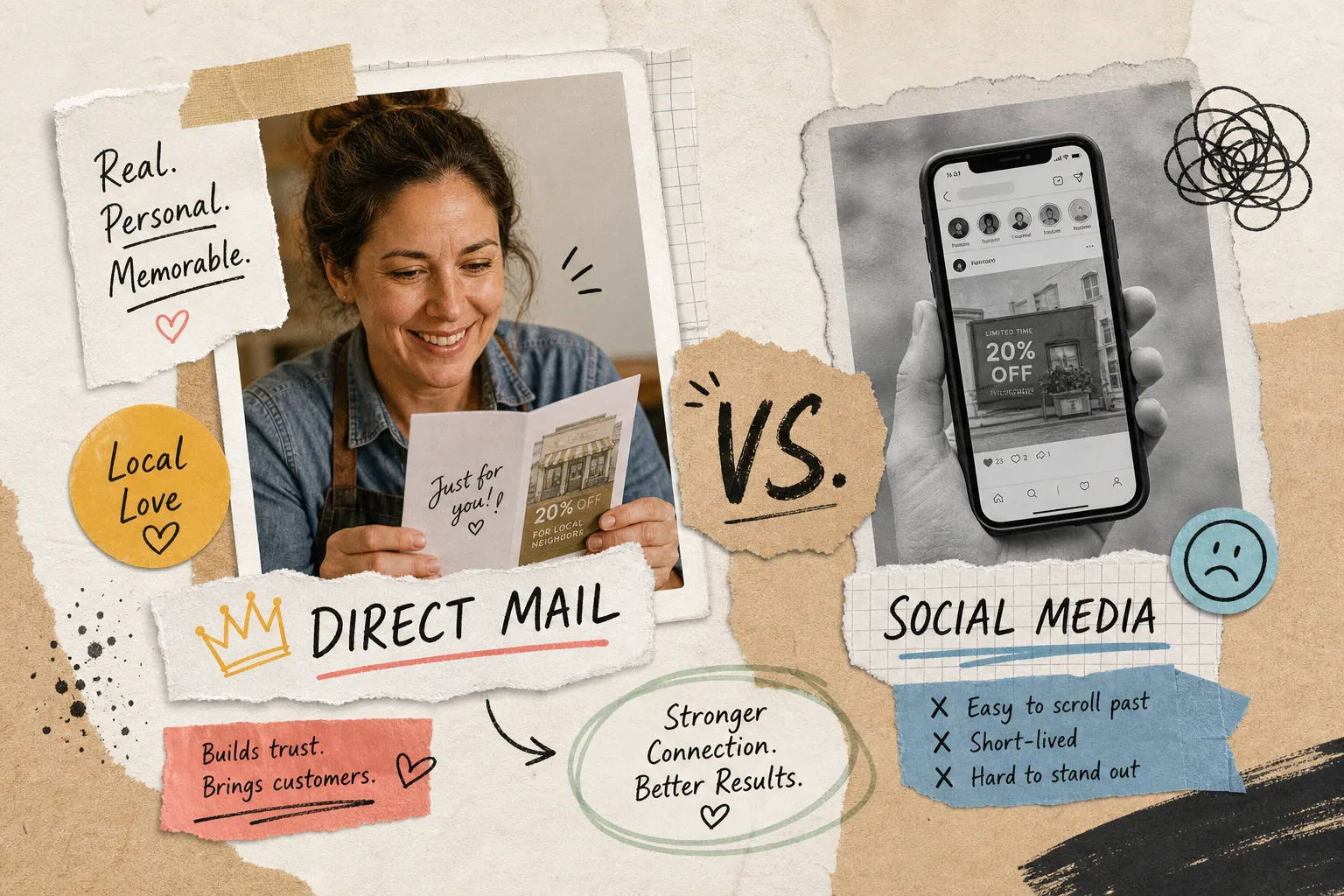
Why does direct mail work better than social media for local businesses? Picture this: you've spent $300 on a Facebook ad campaign, watched the impressions tick past 4,000, and then sat by the phone waiting for it to ring. It doesn't. You check the analytics, see a 0.3% click-through rate, and wonder what went wrong. Nothing went wrong, exactly. You just chose a channel built for scrolling, not for calling. This is what countless local trades and service businesses across Canberra's suburbs experience every week, and it's why many of them are quietly returning to the letterbox.
Services like Capital Connection by CanberraMailer have built their entire model around this insight: a premium postcard, delivered to 2,500 Belconnen households, generates a fundamentally different kind of response than a boosted post. This article breaks down exactly why, using response rate benchmarks, cost-per-lead comparisons, and the psychology behind why a physical piece of mail holds attention in a way a feed post simply cannot. You'll also find a practical four-step framework for running your first trackable direct mail test, so you can measure the result against whatever you're spending on digital right now.
Why direct mail works better than social media for local businesses: the response rate gap
What the numbers show for prospect-list campaigns
Direct mail to a cold prospect list (households in a defined suburb who haven't bought from you before) typically produces a response rate of 2% to 5%. Social media direct-response campaigns to a comparable audience generally land somewhere between 0.08% and 1.5%, depending on the platform, the creative, and how tightly the targeting is set. That's not a small edge. That's a structural difference in how people engage with each channel.
To make it concrete: a neighbourhood mailing to 2,500 homes at a conservative 2% response rate produces around 50 direct enquiries. A social media campaign served to the same number of people at 0.5% produces about 12. For a plumber or electrician trying to fill their calendar, that gap matters enormously, and it repeats with every single mailing.
Why warm audiences push direct mail even further ahead
For businesses mailing to an existing customer base or warm local prospect list, response rates climb considerably higher. Published industry benchmarks report 5% to 9% for well-matched lists, with some well-run campaigns pushing beyond that. Social media retargeting exists for the same warm-audience concept, but it still underperforms physical mail on direct-response metrics for most local operators. Platform auction systems and frequency controls mean the algorithm decides when and how often your ad appears, on the platform's schedule, not yours. A piece of physical mail arrives on your terms.
For trades and home service businesses, the practical translation is straightforward. A past customer who lives two streets away is an exceptionally warm prospect. Reaching them through the letterbox, without any algorithmic interference, is both reliable and repeatable in a way that retargeted social ads are not.
Shelf life: why a postcard outlasts a social post by weeks
How long direct mail actually stays in the home
Australian consumers keep useful direct mail items for an average of 17 days before discarding them, according to Australia Post consumer research. One consumer survey found that 58% of people store their mail for later reference. A well-designed postcard containing local contact information and useful content, the kind that gets stuck on a fridge or pinned to a noticeboard, generates repeated impressions at zero additional cost across that entire period. A social media ad, by contrast, competes with hundreds of other posts and is typically seen for only a matter of seconds before the feed moves on.
This time-value dimension is one of the most underappreciated advantages physical mail holds over digital advertising. A single mailing isn't just one impression. It's potentially dozens, spread across days or weeks, in a high-attention environment: the home.
The passive top-of-mind effect and what it means for local trades
There's a cumulative psychology at work here. A postcard seen five or six times across a fortnight builds genuine brand recognition in a way a single-scroll social impression cannot replicate. For a plumber, cleaner, or electrician, this matters because the purchase decision is almost always delayed until a need arises. The business whose name is visible on the fridge is the one that gets called when the hot water system fails on a Sunday evening.
Physical, tactile materials create stronger multisensory memory encoding than screen-based ads, a finding supported across consumer psychology literature. Touch adds diagnostic information and emotional salience, both of which make a brand easier to remember and easier to trust when the need finally surfaces.
Why the letterbox beats the algorithm for neighbourhood targeting
Geographic certainty versus lookalike guesswork
Many small business owners assume digital advertising offers more precise targeting than physical mail. For suburb-level campaigns, the opposite is often true. A letterbox drop to a defined area like Belconnen delivers to every nominated household on the route, with minimal impression wastage on users outside the target geography, though it's worth noting that some households display "No unaddressed advertising material" notices, which Australia Post delivery contractors are required to observe. Social media's geographic targeting works on approximate radius settings and demographic overlaps, and the algorithm optimises for engagement metrics rather than local relevance. A business whose entire customer base lives within a five-kilometre radius gets direct, predictable control with physical mail that platform targeting struggles to replicate.
The demographics that respond most to local mail campaigns
Studies of direct mail response patterns identify older homeowners, particularly the 45 to 65 age bracket, and middle-aged families as the most responsive segments for direct mail campaigns. For trades and home service businesses, this demographic profile aligns closely with the typical customer. Homeowners in this bracket are more likely to have maintenance needs, are often more cautious with new suppliers they find online, and have a well-established habit of keeping useful reference material. Reaching them through the letterbox meets them where they already pay attention.
The real cost comparison: cost-per-lead, not cost-per-click
Breaking down the per-piece economics of a local postcard campaign
A basic postcard campaign at around 1,000 units typically costs between $0.49 and $0.75 per piece, all-in, including design, print, and delivery. At a 2% to 3% response rate, that translates to a cost-per-lead of roughly $16 to $37, depending on the offer and the list quality. Facebook lead campaigns for local service businesses in Australia are currently benchmarked at around $25 to $28 per lead. The comparison is closer than most business owners expect, and direct mail's cost structure has one distinct advantage: it's fixed, transparent, and free from auction dynamics. There are no bid changes, no budget surprises, and no platform algorithm deciding whether your ad gets shown today.
When a shared campaign structure makes the economics even stronger
The co-op or shared postcard model compresses per-piece cost significantly further. When multiple non-competing businesses share the production and delivery cost of a single premium postcard, each advertiser's effective spend drops sharply without any reduction in reach. Capital Connection's shared community postcard is a working example of this model: a standard placement on the card, reaching 2,500 Belconnen homes, starts at $150. That works out to roughly $0.06 per household. At a conservative 2% response rate, that's around 50 potential enquiries for a $150 investment, before any multiplier from the postcard's shelf life is factored in. Contact Capital Connection directly to confirm current pricing and placement terms.
How a shared community postcard delivers results without algorithm dependency
What category exclusivity means in practice for a local tradie
Capital Connection states that its postcard offers category exclusivity to advertisers: one electrician, one plumber, one cleaner, one landscaper. No competing business from the same category appears alongside them. Every household receiving the card sees a single representative from each trade, which means the advertiser holds a category position in front of 2,500 local homes. A Facebook ad, shown in the same feed as competitor ads from the same industry, cannot offer this. For a small operator with a limited budget and a specific local service area, category exclusivity is a meaningful commercial advantage. Confirm current category availability directly with Capital Connection before booking.
Why the postcard is designed to stay, not be thrown away
The postcard format used by Capital Connection incorporates useful local information and community content alongside the advertising, with the explicit goal of encouraging residents to keep it rather than bin it. This extends the active lifespan of each ad well beyond delivery day, compounding the response opportunity over time as the postcard remains visible in the home. A tangible, fridge-worthy piece of creative that keeps a business name in front of a household for weeks is a physical-media advantage with no direct digital equivalent.
A simple 4-step test to measure your direct mail ROI
Steps 1 and 2: Define your target area and set a trackable offer
Start by choosing a single defined suburb or postcode for your first drop. Trying to cover too wide an area in a test mailing dilutes the data and makes it harder to evaluate what's working. Once the area is set, build a trackable mechanism into your offer. A dedicated phone number that only appears on the mail piece, a unique promo code, or a specific landing page URL, these are the tools that turn a gut feeling into a measurable result. Without one of them in place, you're guessing at what the mailing produced.
Steps 3 and 4: Set a response benchmark and evaluate after one mailing
For a cold prospect list in a local residential area, published benchmarks suggest a response rate somewhere in the 2% to 4% range, though results vary by list quality, offer strength, and category. Before the mailing goes out, calculate the break-even number: how many jobs or bookings do you need to cover the campaign cost and return a profit? If your average job value is $400 and the campaign costs $150, you need fewer than one confirmed booking to break even, and every additional response after that is margin. Run the mailing, track the responses against your dedicated phone number or code, and compare the result to your benchmark.
One mailing is a data point, not a verdict. The cumulative recognition effect discussed earlier builds across repeated drops to the same households. A single mailing tells you whether the channel works at all; a consistent quarterly schedule tells you what it's worth to your business over time. The most effective direct mail campaigns are the ones that show up predictably in the same letterboxes, month after month, until the business name becomes the obvious choice when a need arises.
Why direct mail works better than social media for local businesses: the plain-terms case
The case for physical mail over social media advertising isn't built on nostalgia. It's built on response rate data, cost-per-lead figures, and the measurable length of time an impression stays active in a home. Direct mail frequently outperforms social media on direct-response rates for local campaigns, stays visible for an average of 17 days after delivery, and reaches a defined geographic area with a precision that platform algorithms find difficult to match. Social media has genuine strengths for awareness and content distribution, but for a local trade or service business trying to generate phone calls from nearby households, the letterbox is the more reliable channel.
If you want to understand why direct mail works better than social media for local businesses, the most direct answer is to run a test against your current spend. Capital Connection by CanberraMailer offers Belconnen businesses a low-cost, done-for-you entry point into postcard marketing: a shared premium postcard, no design fees, category exclusivity, and delivery to 2,500 local homes. Get in touch to check current placement availability and find out whether your category is still open on the next mailing.
Related Links & Resources
Community Engagement
No comments yet. Be the first to share your thoughts!
Leave a Comment
How Much Does Local Advertising Really Cost?
See a side-by-side breakdown of the real cost of reaching 2,500 Belconnen households - direct mail, newspaper ads, Google, Facebook, and more.
Get the Free Cost Comparison