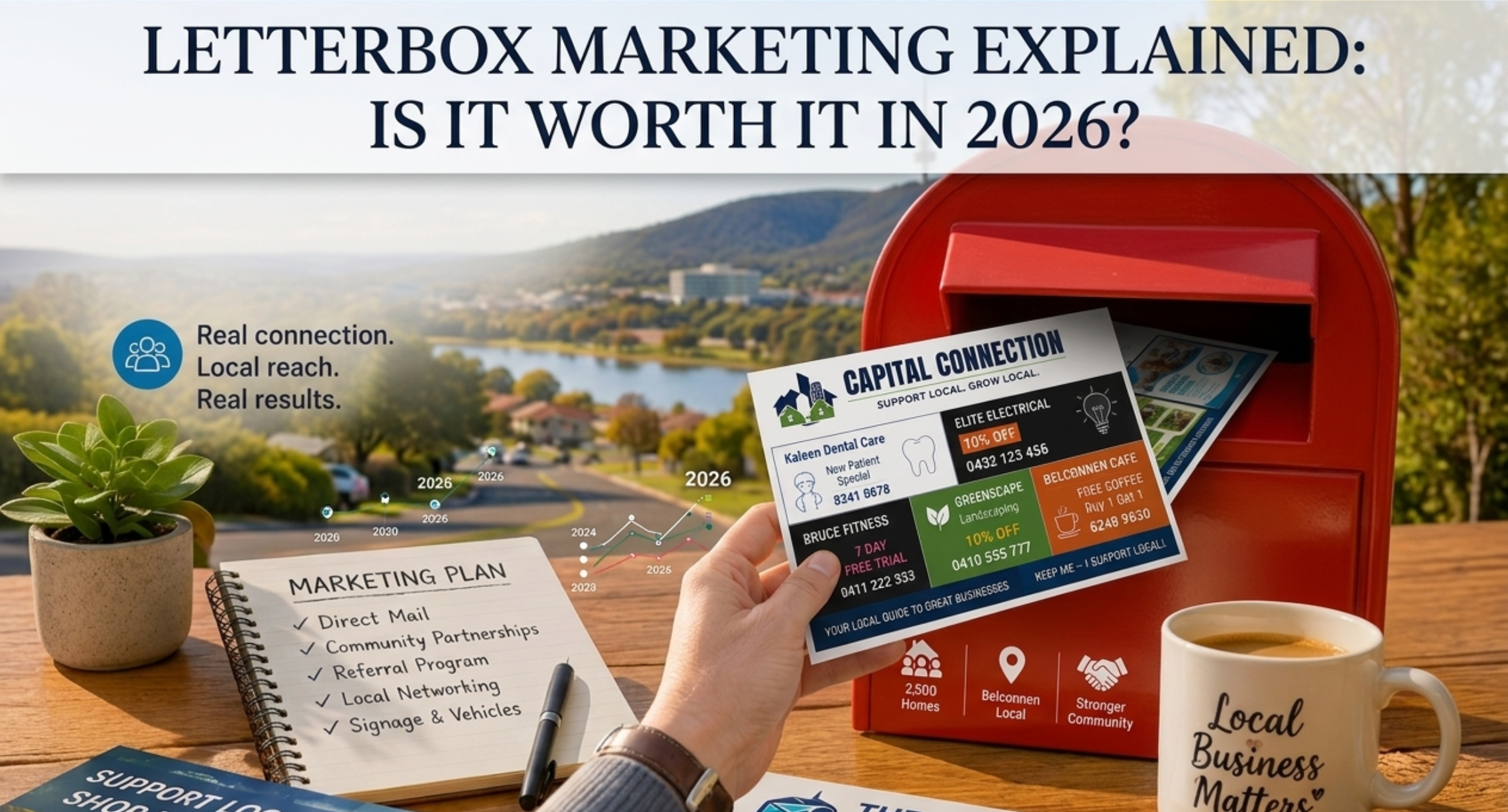
What is letterbox marketing, and is it worth it for local businesses in 2026? Find out how door-drop advertising actually functions and when it makes financial sense to pursue it.
Those are fair questions, and the honest answer is more nuanced than most marketing blogs let on. Some assume physical mail is dead. Many local business owners have shifted their budgets to Facebook and Google and moved on. But the numbers behind door-drop advertising don't support that assumption, and a lot of small businesses are quietly using letterbox campaigns to fill their schedules while competitors chase algorithm updates.
The real question isn't whether letterbox marketing still works. It's whether it works for your business, your budget, and your neighborhood. Local businesses in the Belconnen area, for example, have been using community postcards through Capital Connection as a cost-shared entry point into direct mail, which raises a broader question about how door-drop advertising actually functions and when it makes financial sense to pursue it. This article defines it, costs it out, compares it to digital, and shows what separates a campaign that produces calls from one that gets tossed on the way through the front door.
What letterbox marketing actually is and how it differs from regular direct mail
Letterbox marketing, also called a door-drop, leaflet drop, leaflet distribution, or flyer delivery, is the distribution of printed promotional materials directly into residential or business letterboxes across a defined geographic area. The key word is area. No mailing list is required. The material goes to every home in a street, suburb, or zip code, which is what makes it structurally different from the other form of direct mail most people know.
Addressed direct mail is personalized and list-driven. It goes to specific named people at specific addresses, which allows for tailored messaging but requires owning or purchasing a list. Letterbox advertising is place-based, not recipient-based. You choose the zone; the material reaches everyone inside it. Each method serves a different purpose, and confusing the two leads to mismatched expectations.
What actually gets delivered, and why format matters
The format range is wide: single-sheet flyers, folded leaflets, brochures, postcards, and pamphlet distribution pieces. Format affects more than aesthetics. A single-sheet flyer printed on standard paper tends to move quickly from the letterbox to the recycling bin, research on direct mail engagement consistently shows that higher-quality stock produces measurably better results, with premium formats generating around an 18% uplift in engagement. A quality card stock postcard has a different fate: it sits on a kitchen counter, gets stuck to a fridge, or gets passed to a partner to look at later. Shelf life is a real variable, and businesses that choose premium formats for their door-drop campaigns are investing in persistence, not just first impressions. (See practical tips to increase direct mail response rates.)
How geographic targeting works in practice
The real lever in any door-drop campaign is choosing the right delivery zone. Trades and home service businesses benefit most from tight neighborhood targeting, reaching households within a defined service radius rather than blanketing a wide area. A plumber whose territory covers a few suburbs doesn't need to pay for distribution across an entire city. The discipline is in narrowing the zone to match where the business actually operates.
What is letterbox marketing worth? Costs and response rates explained
A basic saturation drop in the U.S. runs roughly $250 to $900 per 1,000 homes all-in, depending on format and whether design and print are handled separately (figures drawn from 2026 USPS EDDM benchmarks and vendor estimates showing direct mail cost ranges). Letter-in-envelope formats run higher, closer to $650 to $1,750 per 1,000. Solo campaigns add up fast when design, printing, and distribution are costed separately, which is one reason many small businesses never run them at all.
Response rates by industry
Overall response rates for letterbox campaigns typically land between 0.5% and 3%, with local service businesses (plumbing, electrical, cleaning) and real estate sitting toward the stronger end of that range. Industry benchmark data puts service providers at around 3.16% and home services at approximately 3.75%, while restaurants and retail typically land close to the 3% mark when the offer is specific and time-limited. Treat these as planning benchmarks, not performance guarantees (for broader context see a complete guide to door-drop marketing).
Translating percentages into practical numbers: a 1% response rate from 2,500 homes equals 25 contacts. At a 3% rate, that's 75. Whether those numbers justify the spend depends entirely on the value of a new customer in your category. This is where the ROI check below becomes essential.
A simple back-of-envelope ROI check
Before committing to a campaign, run this calculation: take your estimated cost per drop, divide it by your expected response rate, then divide again by your conversion rate (the percentage of respondents who actually become paying customers). That produces a cost-per-customer figure. If that number sits below the lifetime value of a new customer in your business, the campaign pays for itself. A plumber whose average job is worth $400 and whose customer returns twice a year is working with very different math than a café trying to sell $6 coffees.
How letterbox advertising compares to digital channels for local businesses
The honest answer is that neither channel wins across every scenario. Digital campaigns offer faster iteration, easier A/B testing, and more granular audience data. Google Ads reaches people actively searching for a service right now, which is a genuine intent advantage. Pay-per-click campaigns can be paused or adjusted in real time, making them a lower-risk entry point for businesses testing cold audiences.
But letterbox advertising has a structural advantage that digital can't replicate: there's no algorithm deciding whether your message gets seen, no ad auction inflating your costs, and no screen for someone to scroll past. A postcard sitting on a kitchen counter has a different kind of presence than a Facebook ad that disappears in three seconds. Direct mail response rates frequently outperform cold email in industry benchmark sets, and door-drop formats reach demographics who are less responsive to digital advertising entirely, including older homeowners who represent a significant share of home service buyers.
The most effective local marketing typically layers both. A household sees a postcard in the letterbox and then recognizes the same business name in a Google search a week later. Familiarity accelerates trust, and letterbox advertising builds that familiarity across a defined neighborhood more efficiently than most digital channels can. It's not a replacement for digital; it's a complement that most small businesses underuse. For a Canberra-focused perspective on why that balance matters, see Direct Mail Is Making a Comeback for Canberra Businesses.
What separates a letterbox campaign that works from one that gets binned
Most failed door-drop campaigns fail for the same predictable reasons: the wrong streets, a weak offer, a cluttered design, and no way to track whether anyone responded. These aren't mysteries, they're fixable decisions.
Targeting the right streets, not just any street
The tightest-performing campaigns focus on households most likely to need the service: homes in a specific suburb, new movers in an area, or streets within a defined service radius. Scattergun distribution across wide areas dilutes cost-effectiveness and inflates the cost-per-customer figure significantly. Narrower zones with higher relevance consistently outperform broad direct mail drops with a generic message.
Design and offer principles that lift response rates
The message needs to do its work in the first second someone holds the piece. That means one clear action, a visible offer, and enough white space that the piece doesn't feel like a grocery catalog. Colorful postcards produce around 42% higher response rates than black-and-white versions, and pieces with testimonials outperform those without by approximately 30%. A time-limited offer adds urgency that boosts response meaningfully, and the headline should answer "what do I get?" before it answers "who are you?" These figures reflect industry best-practice benchmarks from direct mail studies and vendor research; treat them as directional guides rather than absolute predictions. For practical implementation and targeting tips, review best practices for targeted direct mail.
Simple tracking methods every small business can use
Assign a unique phone number, promo code, or landing page URL to each campaign. This requires no expensive software. A trackable promo code on a postcard costs nothing to set up and immediately tells you whether the drop generated calls. Without tracking, you have no way to decide whether to run it again, scale it up, or change something. The tracking step is where most small businesses skip a corner they shouldn't cut.
Is letterbox marketing worth it? A lower-cost way in through shared postcard marketing
Running a solo letterbox campaign to 2,500 homes can cost several hundred to over a thousand dollars before a single call comes in. For a sole trader or small service business without an existing marketing system, that upfront risk is a real barrier.
Design, printing, and distribution all need coordinating, and most business owners don't have time to manage any of it. The cost of getting one piece wrong can wipe out the ROI before the campaign even runs. That's not a reason to avoid door-to-door leaflet marketing; it's a reason to find a model that removes the execution burden.
The shared community postcard model changes the economics significantly. When multiple local businesses share the cost of a single professionally designed and printed postcard, each advertiser pays a fraction of what a solo pamphlet distribution or direct mail drop would cost. Capital Connection runs this model in the Belconnen area, delivering community postcards to 2,500 residential homes per edition. Learn more about this approach in our Local Advertising Belconnen article. Placement starts at $150 with full design, print, and delivery included, no extra charges. The execution burden is removed entirely from the business owner.
The detail that makes this format more valuable than it first appears is category exclusivity. In a shared coupon book or digital directory, a business appears alongside direct competitors. Capital Connection offers one advertiser per industry per mailing, so a plumber, an electrician, or a dentist appears with no rival on the same card. A small business building name recognition in a specific neighborhood can reach 2,500 homes as the only representative of their category. That's a positioning advantage that a standard $150 solo flyer drop in the same zone simply cannot replicate.
The math will tell you what the argument won't
So, is letterbox marketing worth it? For household-based businesses with a clear service area, the answer is often yes, when the targeting, offer, and tracking are deliberate. Letterbox marketing is not a relic. It's a channel with documented response rates, a specific audience advantage, and a cost structure that can produce a real return. The main barrier for most small businesses has always been the upfront cost and complexity of going it alone.
Shared community postcard formats remove that barrier. If door-drop advertising is something you've been curious about but haven't tested, start small and measurably: define a tight delivery zone, use a clear promo code, and count the responses. Calculate the cost per customer after the first run. The math will tell you whether it's worth scaling more reliably than any opinion, including this one.
The question of what letterbox marketing is worth isn't answered in general, it's answered by your numbers, your neighborhood, and your customer value. Run the test, track the result, and let the data make the decision.
Related Links & Resources
Community Engagement
No comments yet. Be the first to share your thoughts!
Leave a Comment
How Much Does Local Advertising Really Cost?
See a side-by-side breakdown of the real cost of reaching 2,500 Belconnen households - direct mail, newspaper ads, Google, Facebook, and more.
Get the Free Cost Comparison